Sequence steps: every step you can add
Every step of the sequence builder: profile visits, connection requests, messages, likes, withdrawals, emails, delays, waits, conditions, filters and AI steps.
Updated October 13, 2026
On this page
A sequence is a series of steps that each lead of the campaign goes through, from top to bottom: LinkedIn actions, emails, delays, waits and conditions that split the flow into a Yes and a No branch. This article lists every step of the builder and how it behaves.
How the builder works
Open a campaign on its Sequence tab.
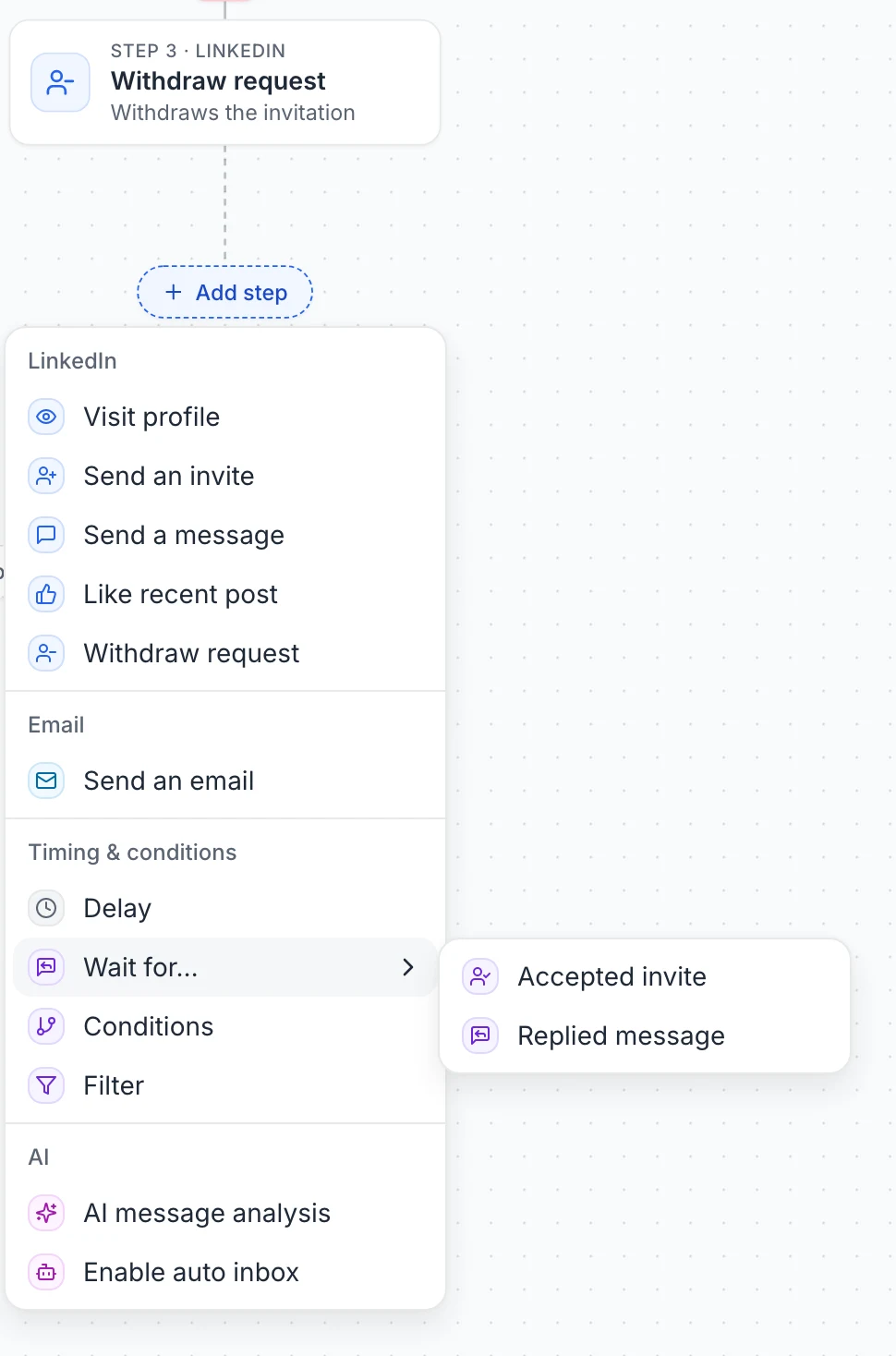
- Add a step at the end of a branch with Add step, or between two steps with the + on the connector (Insert a step here).
- Edit a step by clicking it: its settings open in the panel on the right. Hovering a step shows Edit step and Delete step.
- Branching steps (waits, conditions, filters and AI message analysis) have a Yes and a No branch. When you insert one between two steps, the steps that followed go on its Yes branch and the No branch starts empty.
- Deleting a branching step also deletes everything on its No branch (you're asked to confirm). Its Yes branch is reconnected in its place.
- Steps can't be dragged. Use the controls at the bottom of the canvas to zoom, go back to the start or fit the whole sequence on screen.
- A step that isn't fully set up shows a warning on its card, such as Choose a LinkedIn account, Write the message, Choose a mailbox or Set up the filter.
Changes save automatically. See Pause, resume, edit or delete a campaign before editing a running campaign.
Start
The first step holds the target list. Select it under Select target list. Leads of this list enter the sequence when you launch the campaign.
LinkedIn steps
Each LinkedIn step needs an account under Select an account, unless the campaign rotates between several accounts (then each lead uses its assigned account for all its LinkedIn steps). See Working hours, daily limits and sender accounts.
Visit profile
Visits the lead's LinkedIn profile. The visit is real: the lead can see it in their profile viewers.
Send an invite
Shown as Connection request on the canvas. Sends a LinkedIn invitation, with or without a note.
- Write the note in Add note (optional), with variables such as
{firstname}. See Personalization variables. - Or turn on Write notes with AI to get a different note for each lead. See Write messages with AI.
- The counter shows / 300 characters. LinkedIn allows 300 characters with Premium and 200 without: a longer note is cut. As the builder warns, free LinkedIn accounts can only send a few invitations with a note per month, so on a free account it's better to invite without a note.
- If the lead is already one of your connections, the step counts as done and the lead is marked as accepted. If an invitation is already pending, the step also counts as done.
- After you withdraw an invitation, LinkedIn doesn't let you invite the same person again for about three weeks.
Send a message
Shown as Message on the canvas. Sends a LinkedIn message, written by you (Compose) or by AI (Write message with AI).
LinkedIn messages only reach 1st-degree connections. Put this step on the Yes branch of Invite accepted? (or of an Accepted invite condition). Otherwise the step fails with "Not connected with this lead yet" and the lead moves on to the next step. There's no InMail step.
Like recent post
Likes the lead's most recent post (reposts are skipped). If the lead hasn't posted recently, the step fails with "No recent post to like" and the lead moves on.
Withdraw request
Withdraws the pending invitation sent to the lead. If there's none (the lead accepted, or no invitation was sent), the step counts as done. The default sequence uses it on the No branch of Invite accepted? to keep your pending invitations low.
Email step
Send an email sends an email from one of your connected mailboxes. See Connect Gmail, Connect Outlook or Connect any mailbox with SMTP.
- Email account: the mailbox that sends. A mailbox marked (reconnect needed) can't be selected until you reconnect it.
- Subject: required on the first email of the sequence. Leave it empty on a later email to reply in the same thread as the previous one ("Re: …").
- Message: the body, with variables and the
{unsubscribe}link. See Personalization variables. - Include signature: adds the mailbox signature, set in Settings › Email accounts.
- Send me a test email: sends the step to your own account email from the selected mailbox, with "[Test]" before the subject. In the test, only
{firstname},{lastname}and{companyname}are filled in, with your own details.
The email goes to the lead's email address (addresses marked invalid are ignored). A lead without an email address is skipped. Use Find emails for a list before launching. Addresses that unsubscribed or bounced are skipped too. Opens and clicks are tracked automatically.
Timing and conditions
Delay
Waits before the next step: Wait for a whole number of hours or days (minimum 1 hour). A new delay starts at 2 days. The delay counts nights and weekends; the action that follows is then sent within the campaign's working hours.
Wait for… › Accepted invite
Shown as Invite accepted?. The lead stays on this step until they accept your invitation (Yes branch) or until the waiting period ends (No branch). Set the period in Wait for the invite to be accepted during (4 days for a new step). Select the account that sent the invitation.
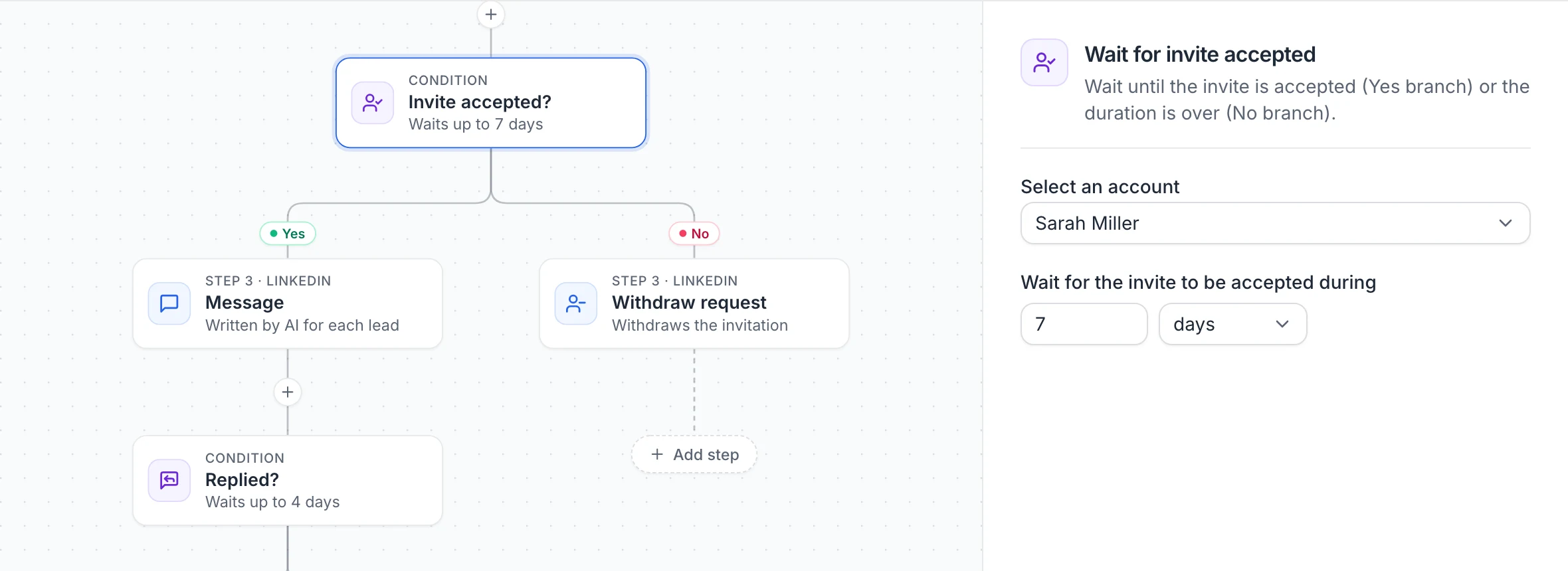
The lead moves on as soon as the acceptance is detected, which can take a few hours. At the end of the period, the connection is checked one last time before taking the No branch.
Wait for… › Replied message
Shown as Replied?. The lead stays on this step until they reply (Yes branch) or the period set in Wait for a reply during ends (No branch, 4 days for a new step). Replies on LinkedIn and replies to the campaign's emails both count.
Conditions
A condition checks something right away, without waiting, and sends the lead to Yes or No. Under If the lead : choose:
- is in my relations: connected with the LinkedIn account selected under to my account :
- has sent a Linkedin message: replied on LinkedIn to that account
- has replied an email
- has opened an email
- has clicked a link in email
From the + on a connector, Conditions offers these as presets: Accepted invite, Replied message, Replied email, Opened email and Clicked a link in email.
Tip: To give a lead time to act, use Wait for… instead: a condition checks only once, at the moment the lead reaches it.
Filter
Splits leads by a property: choose a Field (Name, Company, Job title, Linkedin, Twitter, or one of the custom properties of the list), a Rule (is, is not, starts with, ends with, contains, do not contain, exists, do not exist) and the text to compare with.
The comparison is exact and case-sensitive. A lead with no value for the field goes to No, except with exists and do not exist. Leads imported from a CSV file have their name, job title and company stored in lowercase, so write your text in lowercase for them.
AI steps
AI message analysis
Reads the LinkedIn conversation with the lead and asks the AI your yes/no question under Prompt (by default "Is the lead interested by my previous message?"). A yes goes to Yes, a no to No. If the lead hasn't replied yet, the lead goes to No. Place it on the Yes branch of a Replied? step.
Enable auto inbox
Shown as AI auto-reply, and only available at the end of a branch. When a lead reaches it, AI replies are turned on for the LinkedIn conversation with that lead: each time they write, an AI reply is sent a few minutes later, based on the conversation and your campaign's pitch and goal. The lead's sequence ends there, so steps placed after it never run. Auto-replies then stay on for that conversation. See Reply with AI.
When a lead replies
With Stop a lead when they reply on (the default), a lead who replies on LinkedIn or by email is stopped: they get no further LinkedIn action or email from this campaign. If the rest of their path contains a Replied? step, an AI message analysis, an AI auto-reply or a reply condition, they continue so these steps can react. See Pause, resume, edit or delete a campaign.
When a step fails
A step that can't be done is retried when the problem is temporary. Otherwise it's marked as failed or skipped and the lead moves on to the next step. See Queue and failed actions.
Was this article helpful?
Related articles
Still need help?
Write to hello@useartemis.co with your account email and what you were trying to do.